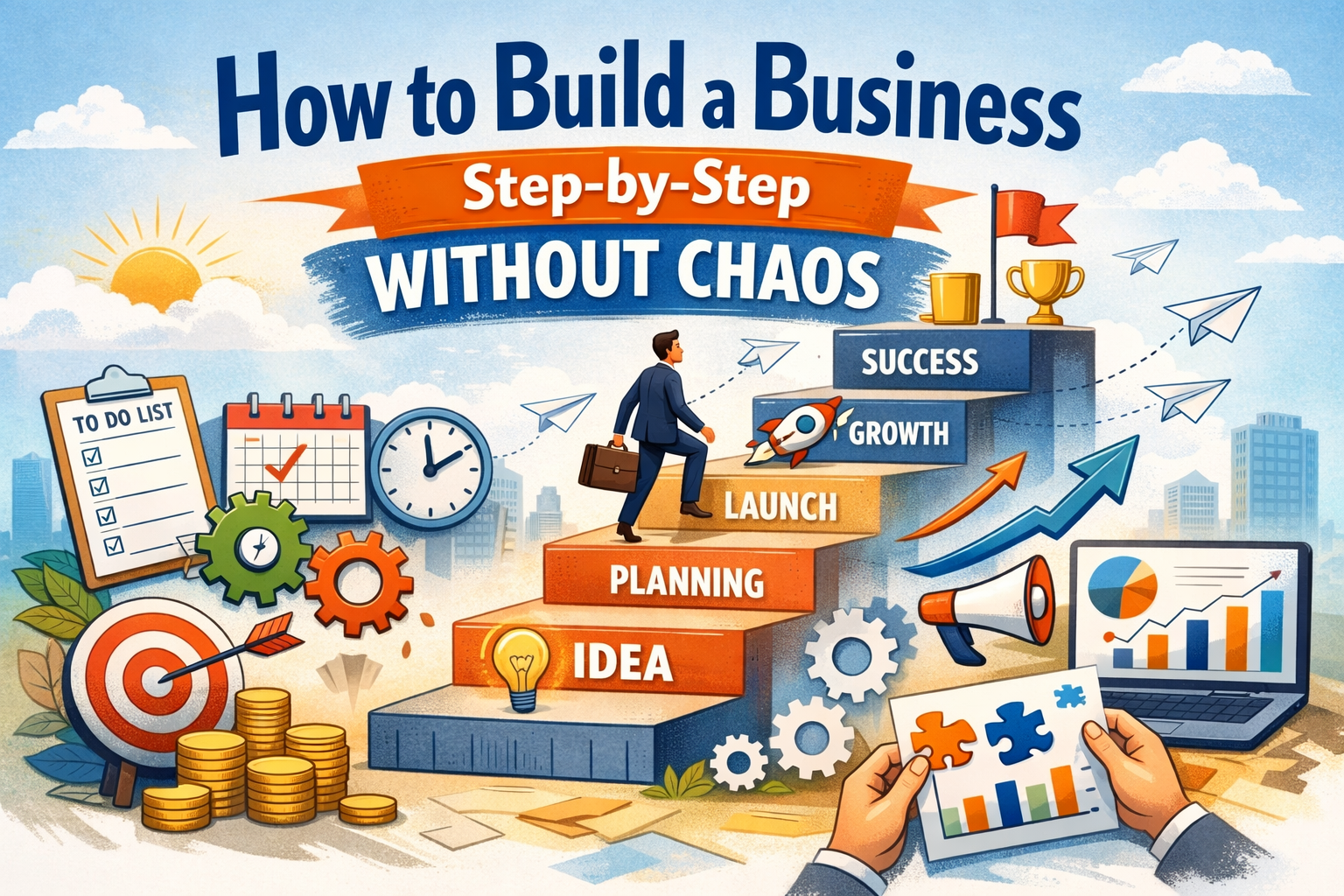
At the start, everything feels scattered. Ideas overlap, priorities shift, and it’s hard to tell what actually matters. That’s why building a business without chaos isn’t about doing everything right — it’s about understanding what to focus on first, and what can wait.
Clarity doesn’t come before action
It’s easy to assume you need a clear plan before you begin. A structured path, defined steps, something that feels complete. But in practice, that clarity usually comes later.
At the beginning, most things are uncertain. You don’t yet know what will work, what will need adjustment, or what might not matter at all. Trying to resolve everything upfront often creates more confusion, not less.
What helps instead is moving with partial clarity. Taking one step, then adjusting. Letting the direction become sharper as you go, rather than expecting it to be perfect from the start.
Not everything needs attention at the same time
One of the main sources of chaos is trying to handle everything at once. Branding, structure, ideas, details — all competing for attention.
But not all parts of a business carry the same weight in the early stages.
Some things move everything forward. Others feel important, but don’t actually change much in the moment. The challenge is recognizing the difference.
A few areas tend to matter more early on:
- understanding what you’re actually offering
- seeing how people respond to it
- adjusting based on that response
Other elements can develop alongside this, but they don’t need to be perfect right away.
When progress feels uneven
There’s a phase where things don’t move in a straight line. One part improves, another becomes unclear. Something works, something else needs rethinking.
That uneven rhythm is normal, but it often feels like something is going wrong.
In reality, this is where structure begins to form. Not as a fixed system, but as something that adapts based on what’s happening. The process becomes less about following steps and more about recognizing patterns.
With time, what felt chaotic starts to feel more connected. Not because everything is resolved, but because you begin to understand how things relate to each other.
A quieter way to stay focused
At some point, the approach changes. You stop trying to control every detail and start narrowing your attention.
Instead of asking “what else should I do,” the question becomes “what actually moves this forward right now?”
That shift reduces noise. It doesn’t remove complexity, but it makes it manageable.
Building a business without chaos isn’t about eliminating uncertainty. It’s about learning how to move through it without letting it pull your focus in too many directions at once.
Closing thought
Structure doesn’t appear all at once. It develops gradually, through action, adjustment, and attention. And once you begin to trust that process, building a business starts to feel less like managing chaos — and more like shaping something that becomes clearer with every step.
No Responses