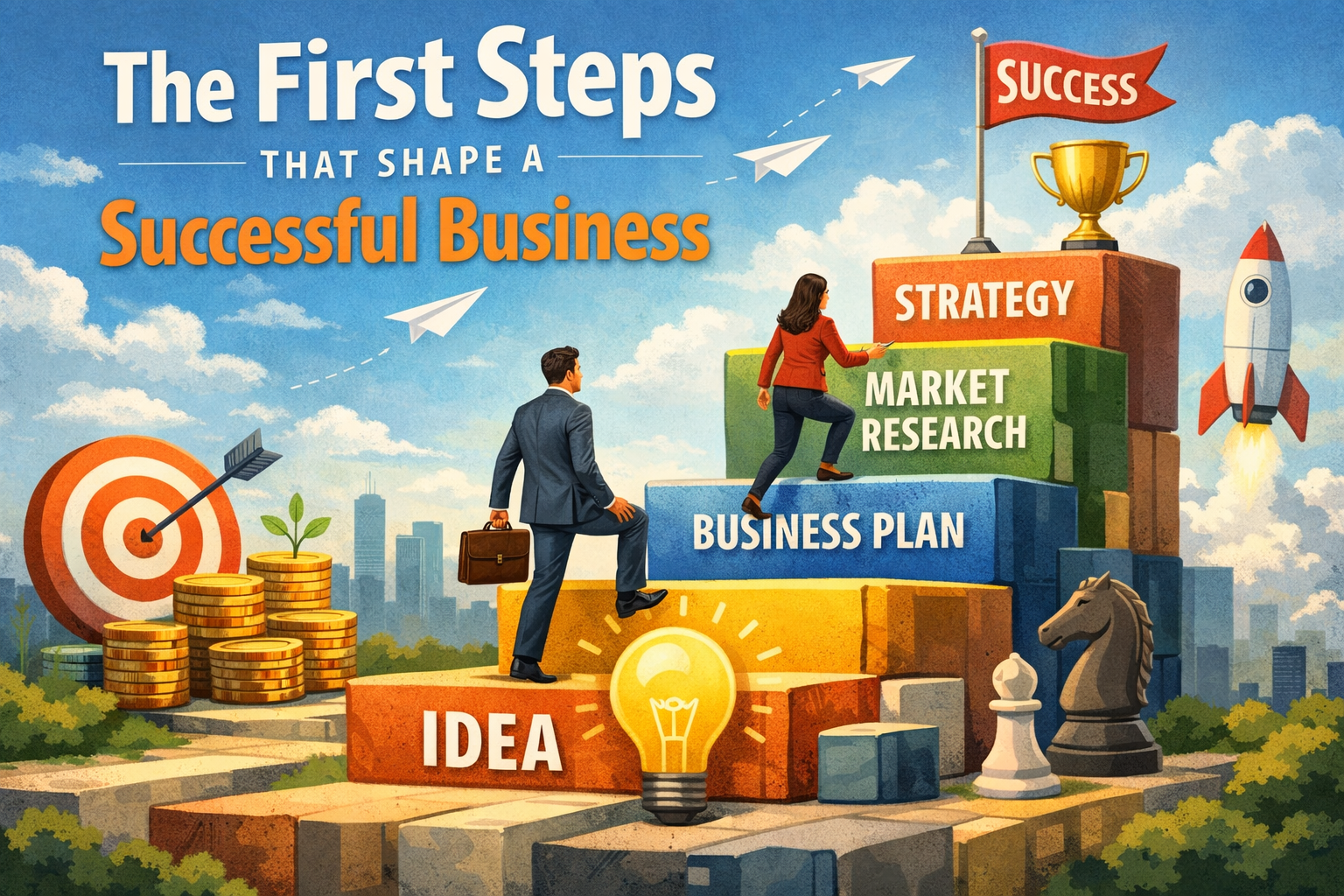
At the beginning, it’s hard to tell which steps actually matter. Everything feels important, and there’s a constant sense that you might miss something. But when a business starts taking shape, it becomes clear that the first steps don’t need to be perfect — they just need to move in the right direction.
It starts before anything looks real
Most early decisions happen before there’s anything visible to show. You’re still working with an idea, trying to understand what it really is and how it fits outside your own perspective.
This stage doesn’t look like progress from the outside. There’s no clear result, no finished structure. But internally, something important is happening — you’re defining the core.
Not in a formal way. More like narrowing it down until it becomes something you can actually explain without overthinking it.
That clarity isn’t complete. But it’s enough to begin.
The first real interaction changes everything
There’s a moment when the idea leaves your head and meets someone else. That interaction, even if it’s simple, shifts the entire process.
You begin to see what translates easily and what doesn’t. What feels obvious to you might need more explanation. Or something you thought was minor suddenly becomes the main point.
These early reactions don’t give full answers, but they shape direction faster than internal thinking ever could.
A few things tend to stand out early:
- whether people understand the idea without effort
- what part of it captures attention first
- where confusion appears naturally
This is where the business begins to form — not as a finished concept, but as something that responds to real input.

When structure starts to appear
At some point, things begin to connect. Not perfectly, but enough to feel more stable.
You notice patterns. What works more consistently. What needs to change. What doesn’t matter as much as you thought.
This stage doesn’t remove uncertainty. It just organizes it.
Instead of everything feeling equally unclear, certain parts become more defined while others remain flexible. That balance allows you to move forward without needing to resolve everything at once.
It’s not a clean process. But it’s a real one.
A different way of moving forward
Early on, there’s often a desire to build quickly — to create something complete as soon as possible. But rushing structure usually leads to confusion later.
What works better is a slower, more deliberate approach. Not slow in action, but careful in focus.
You start to notice what actually moves the business forward and what only feels productive. That distinction becomes easier with time.
And once you see it, decision-making becomes simpler. Not easier, but clearer.
Closing thought
The first steps don’t define everything, but they set the tone for what follows. And when those steps are grounded in real interaction, attention, and adjustment, a business begins to develop not as a fixed plan — but as something that grows into its shape over time.
No Responses